Uncategorized

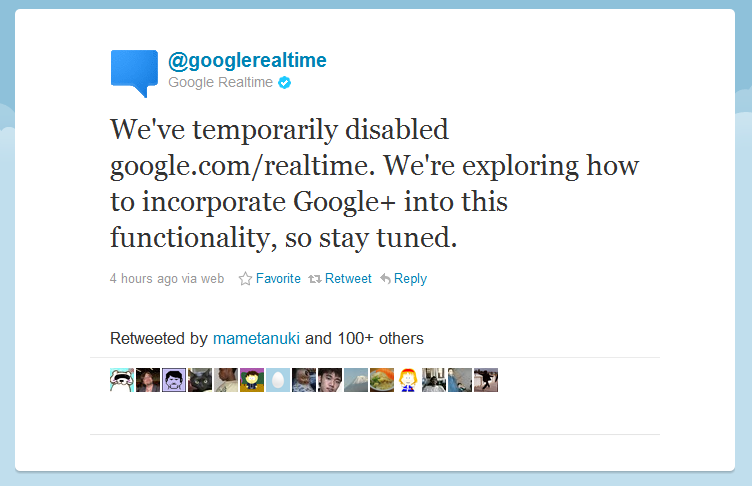
Err, Google, can you bring back realtime search until it moves to Google+…?

Media_httpiimgurcompb_lszmb

via @googlerealtime

That’s rather lame, and no wonder I haven’t been seeing realtime results tonight. And really, they needed to disable the whole thing to test out integration with Google+? 

Considering how pathetic the Twitter search is, Google Realtime, and its timeline view have saved me many a time in trying to find old tweets, and it’s been fantastic in trying to determine whether issues I currently have with a service or website are shared by others across the web, the most recent example being Tumblr’s genius idea to remove the importing of RSS feeds >.<

Continue reading

Standard
Uncategorized

Google+. Initial thoughts from a non-Facebooker.

I’m probably the one person you know [or don’t know] that doesn’t use Facebook. I never saw a need to use it, and coupled with their terrible stance on privacy and general doucheness by Zuckerberg, wouldn’t be caught dead using it. Then Twitter came along and createdshortly filling thereaftera need to consume a constant stream of technology, movie, and cat-related information, amongst other things, and the ability to share all this easily.

Continue reading

Standard
Uncategorized

Why did Tumblr remove the importing of RSS feeds? To conserve resources, apparently…

So Tumblr removed its RSS feed import functionality a week or so ago, and decided not to tell anyone. 

I noticed this a week ago too, when I was frustrated with the lack of data portability with my Flixster ratings, but realised I can pull them into an RSS feed, and thought, hey, I’ll just start pulling them all into a Tumblr blog on the side, and every now and then, use my main Posterous blog for a longer review.

Continue reading

Standard
Uncategorized

It ain’t easy takin’ your blog with you

Steve Rubel tweeted yesterday that he was ditching his existing blogs, and starting again on Tumblr. I assumed that his reasons for moving would probably not convince me, since he does what he does as a profession, but before he posted his reasons why later in the day, I got thinking about moving from Posterous to Tumblr, and decided to give it a go, since he did get me onto Posterous in the first place.

The results were disasterous, and I learned that blogging platforms do NOT play nicely with each other.

I was shocked at how unbelievably painful it is to even attempt to export your data from one blog to another. There’s no concept of a standard format a blog gets exported into, and right now, WordPress seems to be the only middle man, however cumbersome and handicapped He may be, that can actually pull data from most of these blogs, through plugins they’ve developed that access the APIs, and then spit out an XML file of sorts, parts of which can be read, in various ways, by blogging platforms.

Continue reading

Standard
Uncategorized

Did you know Grooveshark had a Video Mode?!

Note: This is for Grooveshark paying members only, as far as I know.

I’d randomly posted on /r/groovesharkplaylists a week or two ago about collaborative playlists, and someone replied today, and in browsing the subreddit again, I came across this post on Grooveshark having a Video Mode

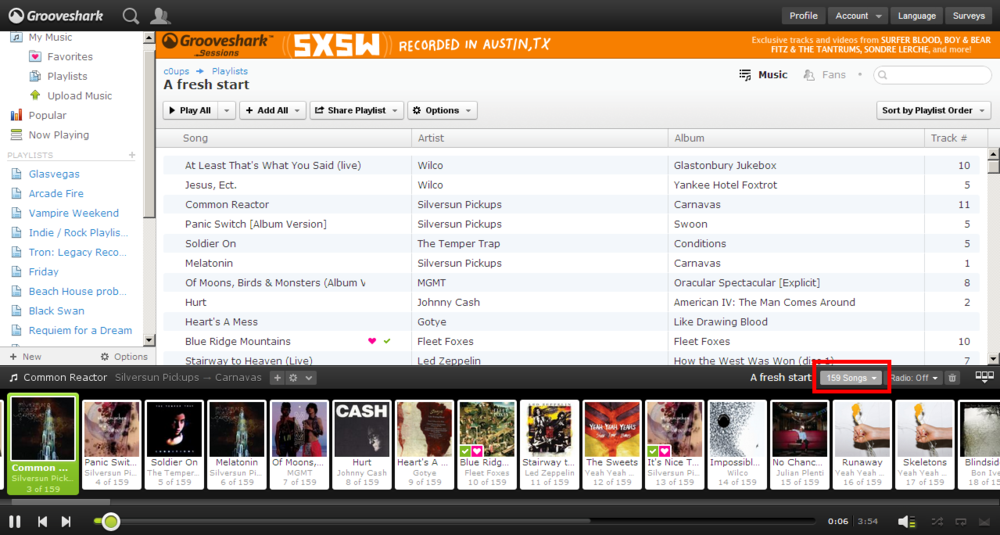
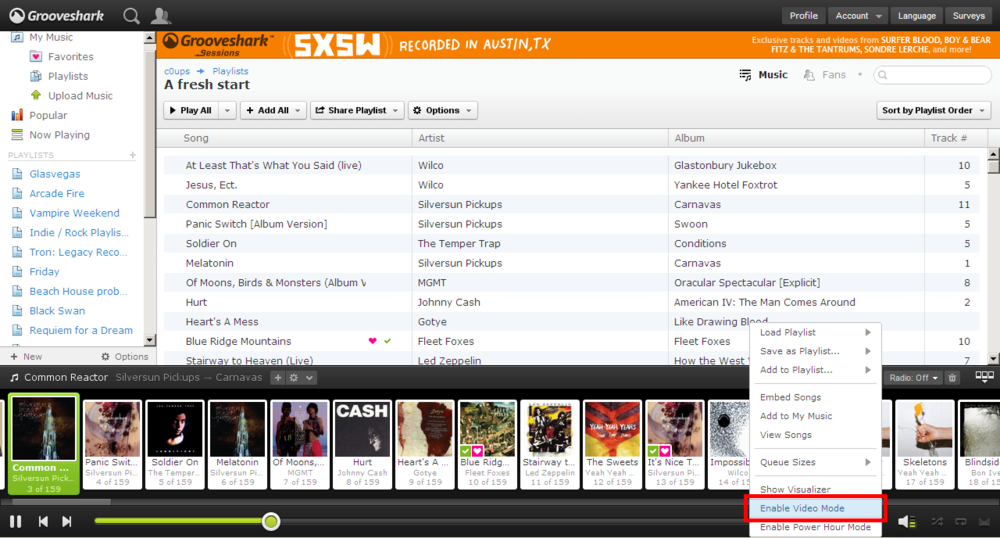
When you have songs in your “Now playing” bar, you will see a song count on the bottom right. If you click on that you get a menu with both these options on it. The video mode displays various YouTube videos that match the current song – very cool

So yeh, I went ahead and tried it, and it does indeed work!

Grooveshark1
Groovehark15
Grooveshark2

I was thinking lately of how I hardly see music videos anymore since I do most of my listening on Grooveshark, but this is quite the convenient indeed!

Standard
Uncategorized

Data is the pollution problem of the information society

Data is the pollution problem of the information society… all processes produce it, it stays around, it has to be dealt with, and its secondary uses are what concern us.. so, just as, we collectively look back at the beginning of the previous century, and sort of marvel at how the titans of industry in their rush to build the industrial age would ignore pollution, I think we here will be judged by our grandchildren and great grandchildren by how well we dealt with data, with individuals and their relationship to their data in the information society

I stumbled across this fascinating 8 min clip of Bruce Schneier speaking at EWI Cybersecurity Summit 2010, and decided it needs to be shared, on a “sticky” platform, like this blog.

Bruce speaks primarily about data and socialising in this increasingly data-producing Information Age we are in, and with the recent #locationgate uproar over data, privacy, etc, I found it most relevant.

Standard
Uncategorized

Rationalising my digital media purchases, or lack thereof

@juleshughan tweeted an interesting Guardian post titled In the digital era free is easy, so how do you persuade people to pay?, and it got me thinking about why I pay for some forms of digital media, and why I refuse to for others.

The article is a good read, and speaks of motivations, which is something I’ve been very interested in lately, but this list, or whatever the post will turn into, is a lot more, colloquial, I guess.

<time jump> I’ve ranted too much [yes, I’m jumping in time], so I’m going to just list my rationale / motivations—generalised—below, and if you’re still interested, you can read about why it was basically World of Warcraft that got me paying for digital media. </time jump>

Note: The following rationale may likely be highly irrational to some.

The short of it

Games

  • Features [the social, multiplayer aspect in 99% of cases] not accessible through pirated copies
  • Ease of purchasing and the convenience of digital delivery
  • Supporting Indie developers

Music

  • Supporting something I’m passionate about
  • It’s cheap
  • Convenience

Television

Good luck trying to get me to pay for television.

Movies

Can’t justify it, and I’m more than doing my bit to support the movie industry by paying $20+ each week at the cinemas.

<time jump 2> Ok, I’m jumping in time again, but I realised I’d forgotten about mobile, and it feels a little different in my mind.

I would more than happily pay for an app I use regularly, but at this point in time, all my favourite, and most used apps, are free. In saying that, I do feel like, for whatever reason, I would hesitate / consider buying an app a lot more than I should, for the relatively small amount they cost. This Oatmeal comic sums it up  </time jump 2>

And now, a wordier version…

Continue reading

Standard
Uncategorized

Where I went yesterday, via my Android phone

You know what? I’m glad this whole phones keeping track of everywhere you go thing happened, because, pushing all those pesky, minor concerns about privacy away, it’s really kind of cool!

Hot on the heels of the iPhone tool that showed us the smorgasbord of data that’s being stored, someone decided to see what Google / Android does. It turns out they store location information as well, just, no way near as much as Apple

After a period of time, 12 hours for cellular data and 48 hours for WiFi data, has passed, the location data is renewed by a new request from Google. It is also limited to a maximum number of entries so that the database doesn’t grow too large. 

Swindon says that the location file pulled from his phone contained roughly 13,000 entries related to cellular network tracking. By contrast the Android file is limited to only 50 entries in the cellular location database.

via The Next Web

Maybe it is just a bug, or lazy programming or whatever on Apple’s part, but it makes sense, especially in Google’s case, where they delete / refresh the data, and you can see it being useful for location-based services.

This same someone that decided to see what Google do, created a Python script that you can feed the Wi-Fi and Cell cache files into, and then output into a .gpx format, to eventually visualise on Google Maps, so I just went ahead and tried it out, purely with my Cell cache file.

Continue reading

Standard
Uncategorized

Why do we do what we do on the web?

SXSW. Day two keynote. Seth Priebatsch’s The game layer on top of the world. Didn’t know what to expect.

Came out beaming, energised, in awe of what a room of 3000 people had achieved in one minute [this crazy card swapping experiment that highlighted the power of decentralised networks and people working together for a cause], and of the new layer that was going to sit on top of the web and make everything better.

Talked about it with everyone, came back home, talked about it some more, ardently defended it in a Twitter exchange just yesterday, and then tonight, after a day ruined by some areshat walking through the wrong door, I started reading up on gamification yet again. The doubt seeped in, and now I’m writing this.

Or maybe it started with that Twitter exchange yesterday, and Pon quoting Josh Williams, co-founder and CEO of Gowalla.

Badges are bullshit. Social validation is the primary driver of activity on the web.

I have been thinking about this over and over, nodding to myself in agreement. He’s right, you know.

Continue reading

Standard